"A Touch of Medieval: Narrative,
Magic and Computer Technology in Massively Multiplayer Computer Role-Playing
Games" ©
2000,2002 Eddo Stern
Published in:
ABSTRACT
The paper provides an in depth examination of the narrative structure
of Massively Multiplayer Online Computer Role-Playing Games (MMORPGs).
The analysis is focused on the narrative complexities created by the
relationships between computer technology, the medieval fantasy that
is central to the genre, and the emergent nature of the online player
society. The paper is divided into four major sections: the first
examines the question of neomedievalism (as pronounced in the 1970's
by Umberto Eco) and its relationship to technology and magic. The
second section recounts the historical development of the MMORPG genre.
The third section examines the narrative form unique to fantasy genre
computer games that arises when the cogent narratives of the fantasy
genre are mixed with the equally fantastic narratives of high tech
computer culture. The fourth section examines a specific set of game
"artifacts" that belong to the specific narrative diegesis
of MMORPGs. Keywords
Massively Multiplayer Online Role-Playing Games, MMORPG, Everquest,
Ultima Online, Asheron's Call, Fantasy, Computer Game Genre, Magic,
Online Games, Role Playing Games, Narratology
MAGIC
& TECHNOLOGY 1.Neomedievalism I
recently visited the 39th Annual Renaissance Pleasure Faire
in San Bernardino California. The creatively anachronistic Renfaire
crowd is comprised of a colorful band of jolly Anglophiles, mediaevalists,
woodworkers, elves, druids and wizards selling handmade crafts, performing
jousts, drinking mead and offering an all out sun-beaten Californian
version of new age virtual reality. On a stroll down Lord Mayor's
walk on my way to Maybower Commons, a middle-aged barbarian
standing behind the counter at the Shepherd's Pye caught my
eye as he sipped a pynt from his king-sized wooden mug. I stopped
in for some ale and mutton and struck up a conversation with the bearded
Mr. William Moody. I was curious to learn what made him wake up on
a fine Sunday morning in August of 2001, don a suit of leather armor,
and open shop at the Renfaire to sell pynts of ale and medieval
pot pyes. Mr. Moody remarked that for him, this sort of getaway was
a much-needed reprise from a daily drudgery and offered a quick escape from the stress of a life governed
by modern technology. I soon learned that in RL, Dr. Bill Moody has
spent the past twenty years debugging assembly code at a southern
california computer chip laboratory. I suspected that Mr. Moody's
particular motivations for timesliping from 21'st century California
to take refuge in 12'th century Medieva were not uncommon among the
inhabitants here at the faire.
In
his 1973 essay, Dreaming in the Middle Ages
[1]
, Umberto Eco discusses the phenomena of neomedievalism.
Eco looks to pop-culture and observes the "avalanche of pseudo
medieval-pulp in paperbacks, midway between Nazi Nostalgia and Occultism".
He notes that many structures that define the western world such as
modern languages, merchant cities, and capitalistic economies find
their roots in the Middle Ages. Eco offers to his readers the following
advice: "If one can not trust literature, one can at least trust pop culture". Pop-culture is at question here and the "pseudo-medieval pulp"
hasn't ceased to froth in the past thirty years. In fact these days,
the phenomenon of neomedievalism is rampantly on the rise, and the
new concoction includes intriguing new ingredients. "Now,
Gandalf, Merlin, and Prospero, I have some exciting news for you boys. From this moment on, you will have to get used to sharing your
towers and castles. Meet the P4, the G4, the VooDoo3, and the T1,
". The beige age of swords and circuitry is upon us!!!
The
Internet-mediated arenas for the hugely popular gaming environments
known as "Massively Multiplayer Online Role Playing Games"
(MMORPGs), Ultima Online's "Britania, Everquest's "Norrath and Asherons Call's "Derreth
are prime loci of our new 21'st century's version of neomedievalism.
The range of historical and cultural influences on the fantasy game
mise-en-scene includes a wild amalgam of Celtic, Gothic, Medieval
and Renaissance combined with a deep commitment to a Wagnerian, Tolkienesque,
Camalotian, and Dungeons & Dragonish verisimilitude. The three aforementioned industry-leading
game worlds are practically identical; all are set in a pseudo-historical
magical medieval realm, offering players a familiar selection of characters,
settings, and motivations. And one must ask if this monotone ubiquity
is a result of market research about the current game-player's zeitgeist,
or of the corporate copycatting so pervasive in the game industry
where each successful game spawns dozens and sometimes hundreds of
clones.
The
bond between magic and computer technology is visible across the cultural
landscape and is by no means unique to computer games. A look to Hollywood
reveals a new spin on the magi-medieval fantasy film genre. Where
RenFaire attendees and fantasy computer game players often
regard their fantasy seriously, film goers are offered a more sarcastic
look at the phenomenon as filmmakers struggle to assert the equation
whence film (can still) represent mainstream culture while narrating
cyberculture as subculture.
"Dungeons
& Dragons" (2000), "Just Visiting" (2001),
"Shrek" (2001) "Harry Potter and the Sorcerer's
Stone"(2001),"Black Knight"(2001) and "Lord
of the Rings: The Fellowship of the Ring" (2001) are examples
of recent movies belonging to a new revisionist fantasy film genre.
While traditional genre films from the late 70's and early 80's like
"The Lord of the Rings" (1978), "Excalibur"
(1981), "Dragonslayer" (1981), and
"Conan the Barbarian" (1982), constructed deep immersive
magi-medieval fantasies, the new fantasy genre films function self-referentially
and often address the real world sociology of the fantasy genre. For
example, the anachronistic slapstick "Just Visiting"
is a tale of a knight and a jester from 12th century France, who are
accidentally transported to 20th century California. The comedy "Black
Knight" inverts this temporal switch by sending a 21'st century
black man back to the Middle Ages. The animation feature "Shrek"
is a computer generated post-modern spoof of the Disney fantasy
films of old. "Dungeons and Dragons" and "Harry
Potter and the Sorcerer Stone" are respectively derived from
the fantasy genre's populous manifestations of the pen and paper roleplaying
game and the current best selling fantasy fiction phenomenon. The
warriors and wizards portrayed in "Dungeons and Dragons"
are geekier than the teenagers we stereotypically imagine rolling
twenty sided dice and eating pizza in their parents' basements. Harry
Potter is a 20th century (celebrity) boy: he eats hamburgers, collects
Harry Potter playing cards, and watches Television. "Lord
of the Rings" in its postmillennial form is a doubly nostalgic
as it gestures not only towards a fantastic-medieval age but also
to the utopian middle-earth of the 1960's.
The
question here is why has neomedievalism resurfaced now precisely at
the apex of the "digital revolution"? I see the answers
to this question hinging on two sets of relationships; the relationship
between the United States' role as media superpower and its deeper
crisis of national history, and A philosophical and historical genealogy
of the connections between magic and technology,
2.The Bonds of Magic and Technology As
the great American superpower matures, its citizens must locate or
generate a historical narrative that validates and befits the "glory”
of their culture. This is a quest for a history, a history that must
run deep. While WW1 and WW2 do indeed serve the American narrative
of righteousness, a quest for deeper pre 20th century roots,
quickly leads through the 18th and 15th century colonialist adventures
to a disconnected and un-inscribed Native American past that is quickly
disclaimed. A much more acceptable lineage for the 21'st Century's
Christian Caucasian Empire would be that of Majestic Europe; colonialist
headquarters, home of kings and queens, kettle of Christianity, fountainhead
of great Art, and Literature, and the self proclaimed cauldron of culture - site of the enlightenment and scientific revolution.
It is within this destination of a fantastic historical quest, replete
with visages of regal power, religion, science and art, that the early
narratives of magic and technology were embroiled in this American
Pathology.
Historically,
magic and technology possess a complex bond; and ever since the Middle
Ages, the discourses of magic, emanating primarily from the pagan
remnants of the Roman Empire, and those of the new scientific reason
have battled for sovereignty over the human soul's epistemological
allegiance
[2]
. The science and magic of farming calendars, home
remedies, astronomical maps and Alchemical concoctions are only
few examples of pre-occupations that originated in the context
of magical belief systems and were gradually transitioned to fall
under a scientific rubric during the Middle Ages[6,8].
More
recently, in California of the 1960's and 1970's, the early seeds
were planted that defined the explosion of personal computers and
the Internet into mainstream pop culture. An anecdotal tale of one
of the first computer games written establishes an early connection
between the 60's and 70's cultures of romantic escapist fantasy and
the then nascent computer culture. As the story goes[9], the early
version of the famous computer game Adventure was first written
for the PDP-10 computer in 1972 by William Crowther during his research
stint at the US Department Of Defense's
ARPANET project. It is perhaps here that the connection between
Dungeons & Dragons (D&D) and computer culture was first established. Crowther recounts his then
recent encounter with D&D,
as the inspiration for Adventure, and incidentally inaugurated
the definitive genre of computer adventure games. Today, we stereotypically
associate socially awkward "geeks" with fantasy games like
the pen and paper Dungeons & Dragons and the popular card
game Magic. These same "geeks" in their pop-cultural
perception often share a passion for computers, science and engineering.
Speculation here may suggest a psychological correlation between adolescence,
social awkwardness, escapist fantasy, and a dubiously close bond with
a non-human entity that forms this archtypical personality.
One
could say that technology operates to realize what was previously
in the hypothetical realm of magic. There is definitely some connection
in the way both magic and technology create a sense of wonder as they
seem to expand upon the notions of what is or has been feasible in
the realm of the real. The assessment that they are part of one and
the same wonder is quite pervasive; just remember Sir Arthur C. Clarke's
famous quote that "any sufficiently advanced technology is indistinguishable
from magic." However the positioning of magic and technology
as opposites is even more common. The official web site for the new
magical/technological MMORPG Arcanum explains the relationship: "Magic and technology are opposites. Magic
bends physical law to the will of the mage. Technology depends on
physical law. And, in the fantasy world of Arcanum the use of technology reinforces physical law, countering
the effect of magic."[1] What is clear is that the desire for
magic and magic-related fantasies frequently surfaces in arenas of
the contemporary world purportedly based on scientific and rational
principles. In his book TechGnosis, Erik Davis has provided
ample evidence of this as he explores the new-age culture of techno-mysticism
tracking many of the cybercultual impulses to mesh the digital with
the magical.
What
follows in this essay is an examination of the emerging narrative
twists and turns that result when computer technology is mingled with
the vicissitudes of magical medieval fantasy. I will briefly introduce
MMORPG genre, where most of the action I have examined takes place.
I will then propose what I see as the central underlying narrative
paradox of medium and message in fantasy computer games by delving
into the clockwork of the industry leading game Everquest to
examine a collection of narrative artifacts (gathered through many
months of addiction
[3]
) where narrative, technology and metaphor collide.
MMORPGS - A HISTORY My
own experience playing MMORPGs began in 1997 playing Ultima Online(UO).
In late 1998 I signed up for the Everquest(EQ) beta test. Since
then I've played EQ,, UO and Asheron's Call(AC) extensively.
The
technical evolution of MMORPGs goes back to the pen and paper Dungeons
& Dragons games of the early 70's. Transferred to the computer
environment, they evolved into the text-based adventures like Adventure
and Zork, and on to early graphical adventure games from the
1980s like Bard's Tale, Wizardry, Might and Magic, and Kings Quest. These, in turn,
provided the staging point for more complex realtime scrolling graphical
2D isometric (fixed perspective) games like the Ultima and
Bauldur's Gate series. While the single player role-playing
games were developing more complex engines and graphical capabilities,
social networked text based gaming environments known as Multi-User
Dungeons (MUDs) were developing into 2D graphical network
games (or Graphical MUDs) like UO, Lineage: the Blood
Pledge and Diablo . Eventually the technologies of realtime 3D graphical games and massive
multiplayer networked communication were merged to make possible today's
real-time 3D graphical MMORPGs such as EQ, AC and the newly released Dark Age of Camelot(DAoC).
3do's
1996 release of Meridian 59 is officially the first proper
3D MMORPG to hit the scene. The game was not marketed "properly"
and was soon eclipsed in public notoriety by Electronic Arts' release
of UO which was released a year later with much publicity.
UO was not the first MMORPG, and to this day the game relies
on a dated 2D isometric game engine, but the fact that is was released
by a major game company capable of providing large backend staff support
with a massive marketing engine ready to harness the huge ready-made
fanbase of the Ultima series, allowed it to occupy the vanguard
of the MMORPG craze.
Games
like Meridian 59, UO, EQ and AC distinguish
themselves as Massively multi-player online games from such
(non massive) multi-player online games such as Diablo or Vampire: the masquerade, by the amount of players that can play
online simultaneously sharing the same world space. The exact numbers
are hard to track but officially disclosed player subscriptions from
late 2001 show UO at around 250,000 players, EQ (released
by SONY Interactive in 1999) somewhere between 400,000 and 700,000
and the new Dark Age of Camelot (DAoC -released by Mythic
Entertainment in late 2001) already nearing 200,000 players. Astonishing
reports regarding the numbers for Lineage:the blood pledge
developed for the truly massive Korean and Japanese gaming markets,
claim an astounding 2,500,000 - 8,000,000 (!!!!!) monthly subscribers.
Not surpassingly, Microsoft, publishers of the struggling AC (released 1999) will not disclose the amount of subscribers but it is
estimated to be around 100,000[10].
Today,
the stakes of the MMORPG industry are extremely high. Monthly subscribers
are well into the millions and a new market of network-ready console-system
users are waiting to join in the action. The latest generation of
consoles like SONY's Playstation 2, Microsoft's Xbox and the Nintendo
Game Cube are 3D optimized, Internet-ready systems. Maintaining a
MMORPG is a gargantuan corporate task, demanding massive backend server
support, impervious server security (as gamers often make the best
hackers ), a continuously upgradable game world, 24 hours /7 days
a week server access with zero downtime, and a committed work force
including "online employees" who provide live in-game tech
support, creative narrative twists, censorship services, dispute arbitration,
and game balance research . While hundreds of titles are released
every year in other game markets such as those for the first-person-shooter
(FPS), sporting, or real-time-strategy (RTS) games, the massive MMORPG
market is at the time of this writing dominated by three lone titles:
UO, EQ, and AC (with DAoC recently gaining
ground). It is disconcerting and quite telling that the most popular
and successful games running on the Internet do not embody the logic
of distribution and multi-authorship, but instead that of monopoly,
centralization, and command & control.
An
MMORPG cannot be completed or "won", it's a never-ending
story. Game developers have become very adept at prolonging the "moments
of ecstasy" that stretch between initiation and finale. By carefully
controlling character progress and consistently updating and patching
the game words to include new sights, sounds and spells through a
steady stream of game patches and expansion packs, narrative resolution
is persistently deferred. An important shift in the role of the corporate
MMORPG developer is worth noting, a shift from a production/distribution
model to a service model. MMORPGs are no longer "just games",
they are a monthly service that is provided indefinitely to highly
committed paying subscribers who must be kept happy to stick with
their game service provider.
Although
several new MMORPG's are scheduled for release in the near future,
including titles like UO 2 (never made it), Neverwinter
Nights, Worlds of Warcraft, Asheron's Call 2, Everquest
2 , Lord Of The Rings (never made it), and Shadowbane, it seems almost inevitable, given the growing demands put on a MMORPG
developer, that only the most massively multinational corporations
like Microsoft, SONY and Electronic Arts will survive to the massively
multiplayer market's endgame.
THE CENTRAL PARRADOX OF SOFTWARE AND NARRATIVE
1. Why MMORPGS? MMORPGs
are positioned as the ultimate "achievement" of today's
technoculture. Combining state-of-the-art 3D graphics and sound with
intercontinental networked multi-user technology, they stand in as
the closest thing to the 21st century cyberpunk fantasy data spaces
of William Gibson's "Matrix"[7] or Neil Stephenson's
"Metaverse"[11]. Yet, given the seemingly infinite
possibilities that current computer technologies offer it is telling
that they have been used to construct infinitely complex settings
for pre-industrial medieval fantasy. In this conflation of alternate
fantasies a strange hybrid artifact is created, as MMORPGs replicate
a pre-industrial world using the most advanced post-industrial tools.
Tech-savvy game-players make demands for cyber-cultural privileges
such as post-human speed, permutable identities, endless virtual regeneration,
tele-presence, and access to non-Cartesian space; all the while desiring
the experience of a nostalgic fantasy of forgetting in a magical medieval
playground. Is it possible to maintain this double fantasy without
either giving up these cyber-cultural privileges or "spoiling"
the immersive medieval fantasy with modern technological interference?
If so, how do these divergent narrative elements manage to co-exist
and what then makes up the "narrative" of such complex arenas
of interaction? These I find to be the central and most intriguing
questions regarding the narrative structure of MMORPGs and other Software/Narrative
hybrids.
2. Terminology Before
these questions are further examined through a taxonomy of narrative
elements, I would like to lay out the structure and terms I will use
to examine the interplay of the various elements that contribute to
the encompassing narrative framework of MMORPGs. The central distinction
I will make is between the diegetic and the extra-diegetic elements
of the game narrative and interface.
Diegetic narrative elements The
diegetic narrative and interface elements exist within the games'
pre-technological magi-medieval mise-en-scene. These elements of the
narrative deny any reference to computer technology and fall in to
two basic categories:
Elements of conventional narrative - narrative elements familiar from the traditional
fiction media of film and literature such as characters, dialogue,
and plot. These elements are often refereed to as "content"
in the software industry by those who deny or are unfamiliar with
Marshall McLuhan's famous statement proclaiming "The Medium is
the Message".
Metaphorically patched artifacts - technological narrative elements that are brought
to fit into the diegesis by the deployment of a metaphor. Most fantasy
game designers would regard visible signs of any technological underpinnings
as unwanted anachronisms that would threaten the constitution of the
immersive fantasy they are attempting to construct. The resulting
by-products of this problem can be found in the designers' introduction
of metaphors that function to assimilate unwanted technological residues
into the narrative diegesis.
Extra-Diegetic narrative elements The
extra-diegetic narrative elements are narrative anomalies that remain
unexplained. These artifacts fall into three basic categories:
Sanctioned artifacts - unexplained narrative anomalies that belong to the
initial game design, but do not make logical sense within a rendition
of a "plausible Fantasy".
Technological artifacts - unexpected narrative elements that affect game play
that are a result of technological side effects.
Gameplayer artifacts - elements of gameplay that are a result of unanticipated
and unsanctioned player participation.
A note on "Artifacts" I
am borrowing the term artifact from computer science where the term
is used in reference to undesired cosmetic disturbances such as jagged
edges or dirty patches in an image file (common in compressed digital
video or jpeg images for example), excess noise or hiss in a sound
stream, or unpredictable ASCII characters in a text file. Artifacts
differ from bugs, which are usually caused by programming mistakes;
artifacts don't prevent functionality per se, but cause an unperfected
aesthetic disturbance.
TAXONOMY OF NARRATIVE ELEMENTS
1.Elements of conventional narrative
Backstory The
user manuals of many computer games provide their readers with what
is known as a backstory. It is often based on a kind of Sci-Fi
and Fantasy archetype:
"In the year 3512 a US Marine spaceship crashes into the fiery planet of Quazzaxt, the entire crew of the Panacia 4000 is
killed on impact except for one sole survivor... You are Sgt Gully
Maxtor, and your mission is to discover the mystery of the Panacia 4000 crash ....You wake up in a prison aboard a garbage barge.....
"
Or
"A long long time ago in the ancient land of
Genereth, the evil warlord Zanereth ruled with an Iron fist...After
a deadly feud with his brother Fondoor, Zanereth banished all the elves and dwarves from his kingdom… You are Bondor, heir to Fondor and you find yoursef
the new young ruler of Genereth's neighboring Kingdom of Mondor... You must avenge the death of your father and bring
the evil Zanereth to Justice....”.
The
intended function of the backstory in the diegesis of a computer
game is to provide a contextual framework for the game narrative that
is soon to unfold in real-time. The relationship between the backstory
and those other elements that make up the game narrative during gameplay
might be compared to the relationship, found in Porn films, between
the negligible narrative plotline, and the de-facto primary
narrative elements which function to elicit the visceral pleasures
of sexual desire.
Seemingly
simple twitch games like Space Invaders or Asteroids do not rely
on a backstory to construct a narrative framework. All we have
in the way of a contextualizing narrative in such games must be derived
from simple metaphoric relationships; "space aliens are attacking
you and you are( in) a spaceship and need to kill them" or
"you are (in) a spaceship stranded in an asteroid belt and
you need to destroy the asteroids so your ship can survive".
A game like Tetris is even sparser in terms of conventional
narrative hooks; simply locating a central metaphor becomes difficult
and the vacuum created by the lack of conventional narrative is filled
by a phenomenological account which could sound like " you
are sitting in front of your computer manipulating colorful falling
blocks trying to arrange complete horizontal rows so the blocks don't
pile up to the top of the screen causing your game of Tetris to end"
[4]
.
Most
recent commercial computer games insist on including a backstory
usually in the form of a printed story in the manual or as a 3D animated
digital video clip playing off the CD . The insistence on backstory
has less to do with artistic vision and more with the prominence of
genre
[5]
minded consumers. Perhaps it is also spurred by
the need of the gaming industry to form itself in Hollywood's image
and conform to its convention of narrative plotlines. It's quite clear
that for most players, considering the backstory of Doom,
Duke Nukem, or Quake is akin to remembering the characters'
names in Deep Throat or My Horney Valentine. Even though
games like EQ and UO provide elaborate and complex backstories,
the significance of these stories in the context of gameplay is minuscule.
I'll testify from my own experience of playing EQ that until
very recently I hadn't glanced at the backstory even though
I had been playing for several years. The inherent interplayer narrative
dynamics of MMORPGs are so complex and compelling that engaging the
backstory becomes redundant
[6]
, this is a great testament to the failure of a
conventional narrative approach with regards to software/narrative
hybrids. The backstory functions as excess skin, completely
redundant, and deemed to be shed. Non Player Characters If
you've seen David Cronnenberg's 1999 film "eXistenZ"
you may recall the odd behavior exhibited by certain automaton-like
characters. These characters would enter into monologue loops repeating
the same sentences over and over waiting for very specific phrases
to be uttered in their vacinity. When the "correct" phrase
would be uttered these characters would suddenly exit their looped
monologue and reveal valuable information. These eXistenZ characters are parodies of computer generated characters which have been
performing in computer games for decades with their autistic conversational
algorithms. In multi-player computer games such computer-generated
characters are called Non Player Characters (NPCs), distinguished
from player characters(PCs) who are controlled by live human players.
The
difficulty met when designing "sensitive" computer characters
stems from a central problem in computer science regarding the processing
of natural language. Advanced artificial intelligence researchers
struggle to address such processes and many approaches using neural
networks, fuzzy logic and reinforcement learning have been developed
to make inroads on the gaps between how humans and machines think.
So it is not surprising that programming believable AI for NPCs still
remains a challenge for game designers. NPCs always stick out as peculiar
technological anomalies focusing attention more on their technical
shortcomings than on their "character". NPCs often find
themselves a ripe topic for ridicule and mockery
[7]
. In fact, most game players do not accept these
characters' role as performing any emotional function in the narrative.
NPCs function primarily as information containers that need
to be opened or as locks that need to be picked with the proper linguistic
key to reveal useful information or to provide prosaic rewards such
as game money, magic items or skill upgrades.
All
said, game developers seem to misinterpret the de-facto narrative
function of NPCs and as in the case of the backstory; NPCs often possess highly detailed histories and share their fabricated
emotions towards PCs and other NPCs alike. It is very telling to watch
young game players interact with NPCs, as they automatically press
the "Of course I do",
"I agree, Sire" or "please tell me more"
buttons to quickly ascend to the conclusion of the "conversation"
when the NPCs will offer a reward or clue.
In
MMORPGs the NPCs perform the solemn role as narrators of the backstory.
Much abused, ridiculed and most often ignored by PCs, it's the NPCs
who put the quest in EQ, as they support the
heavy load of maintaining the hundreds of intertwined plotlines that
function to keep the Fantasy intact.
2.Metaphorically patched artifacts Magic
Tunnels
When
logging into AC one encounters a message reading "Entering
world as [you chosen character name here].” This message is immediately
followed by a fantasmagorically-animated viewpoint speeding through
a spiraling blue tunnel sucking the viewer into the virtual game-space.
At times this journey can take quite a long time, sometimes lasting
over two minutes on a slow net connection. The long loading time needed
to establish the initial contact with the server and download the
current state data of the environment(coordinates and information
about all the monsters, NPCs and other players in the game) can be
discouraging.
Most
computer users are well aware of the varied metaphoric animations
devised to keep us cool while waiting for our "slow" computers
to complete their tasks. Whether copying files, downloading or uploading
data to or from the Internet or waiting for program data to load into
RAM, all computer users are all too familiar with the ubiquitous loading
bar. Besides the standard bar animation, other examples come to mind
of more specifically diegetic loading bar metaphors such the FTP program
Fetch's cute running dog and pie chart animations, or the Windows OS' "flying
files" animation. Some examples from game loading bars include
a cartridge filling up with bullets in Soldier of Fortune, and a magic potion bottle slowly filling up with green
liquid in Prince of Persia. But AC's fullscreen animated
3D tunnel animation wins the loading bar crown, both for visual scale
and complexity and most importantly for depth of metaphor. The time
needed to "enter the world” of AC is disguised by a visual
"metaphoric patch” of 3D time-tunneled transcendent birth. The
animation ostensibly symbolizing the magical shift in reality vaulting
us deep into that clichéd 3D space that exists somewhere inside of
our computers where one day we may meet our lost friends form TRON,
Lawnmower Man, Johnny Neomonic
or the Martrix, or perhaps an animated 3D Dragon, who knows.
Saving
and Camping
When
it comes to our computers, we have all come to expect the option to
stop what we are working on, save it to disk, and then return to continue
working where we left off at a convenient time. We all expect the
save/load options when we write with a word processor as we
expect to pause and resume our CD players and VCRs. Both
UO and EQ have decided to incorporate the "Right
to Save” in the diegesis of their narratives through the (non-magical)
metaphor of "camping". When you are ready to save your game
in UO you must gather the appropriate materials to camp (firewood,
tent etc...) then find an appropriate place to set up camp and only
then may you start camping and eventually log off the server successfully.
If you fail to log off in this manner and simply disconnect your computer
from the network you will be punished. Breaking connection to the
game at critical points of danger is a common crime in online gaming
and the punishment procured in EQ and UO causes your
character to lie prone to looters and predators for several minutes
while you are no longer connected to the game server. The highly competitive
online RTS or real time strategy game Starcraft, punishes such
cyber-escapes to the safe harbor of the real by simply listing the
number of "disconnects" in your character profile. The stigmatization
is acute and the tally of disconnects, be they intentional or accidental,
functions like a publicized police record.
EQ offers an excellent example
of a metaphocically patched narrative artifact in the way it
handles the logoff/save-game process. Saving character data to a remote
server takes time - processor time. A screen message reading "now
saving character data to remote server. Please wait” would be quite
truthful but would offer an interruption to the game's narrative diegesis.
Instead, a series of messages beginning a 30 second countdown read:
”preparing your camp. 30 seconds remaining” then "25
seconds remaining" and so on until the logoff process is
complete. Processing delay time has been masked or patched by a narrative
element suggesting time taken to prepare a camp. In EQ a game
session can easily last twenty hours straight with occasional sessions
lasting up to several days spent waiting in one place for certain
creatures to spawn or pass through an area. Spawning is a process of "refilling" the game world with monsters that
have been killed. Different monsters and computer characters have
different "spawn cycles" lasting anywhere from two minutes
after their death to twelve hours(!) after death for rare characters.
The thirty seconds interval needed to logoff and save EQ
is a curiously short time frame from an EQ narrative point of view but is perceived as being extremely slow and frustrating
in a technological cybercultural context. So much so, that a narrated
metaphorized countdown is nessesary to ease the anxiety of waiting
in the transitional moments from slow game time to fast computer time
as soon as the diegetic switch is flipped off.
Magic
Portals MMORPG
worlds are persistent, vastly expanding, and densely detailed. Thus
a gameplayer is presented with a triple gift of infinity: infinite
expanse, infinite detail and infinite time resulting in infinite possibility.
The question of traversing infinite space is a question of time and
speed. In our strict medieval context, finding speedy transportation
is a curious problem. Having a high level master character ride a
horse for three or more hours to arrive at a nearby city would not
be tolerated by game players
[8]
. So the solution we find in UO, EQ and
AC is that of the ubiquitous magic portal
[9]
.
This
shimmering magical gateway allows the condensation of a sprawling
Cartesian virtual space into a compact non-Cartesian data space; it
allows the player to break the constraints of virtual materiality
and instantaneously "teleport” their avatar to a distant location.
Portals either exist as permanent magical fixtures at specific locations
or are created by magic-using characters. Magic portals serve as "metaphoric
patches" allowing non-linear navigation that takes advantage
of instantaneous Random Access Data Retrieval, a "right” many
post-industrial consumers demand being accustomed to navigating freely
through their CDs, DVDs, Databases, Internet sites, Hypertexts and
Television channels.
A
clear division of power exists between those players who can provide
their own means of teleportation and those who can not. This distribution
of power varies from game to game. In Diablo, for instance,
all players, magic using or not, can cast a "town portal” spell
which allows them to instantaneously return "home” to the safehaven
of the basecamp. In EQ the ability to use teleportation to
move around the gamespace is stratified along a magic-using/non-magic-using
hierarchy, a stratification of power we will find again and again
consistent with the equation: magic = technology = power. One of the best examples of this metaphoric
equation of magic, technology and power can be found in the common
nomenclature where a system administrator of a MUD or MOO is known
as a Wizard, holding Wizard privileges with abilities to control and access
[10]
. Players who can't use magic can't "gate”
(the term used for teleportation in EQ) and as a consequence, they are left either to suffer
long dull minutes or even hours of running to their desired location,
or to beg for the generosity of a high level magic user who can cast
a group teleport spell. In many cases these "primitives"
will have to pay hard platinum (game money) for teleportation services.
The importance of speed as a means of traversing game space and avoiding
the "narrative lulls" which occur during lengthy travel
or "meditation" to recover magical manna, is evidenced by
the unparalleled utility and popularity of spells and items that speed
things up. The Spirit of the Wolf spell, which triples foot
speed, and the manna recovery acceleration spell Clarity are examples of magical spells whose value for the player transcends their
diegitic function in the game (say escaping or running down slow monsters),
as they reduce "downtime" and become tools for the gameplayer
that operate on the very mechanics of the game. Controlling the narrative
flow not unlike the way a faster processor or more RAM would enhance
the performance of time consuming processes such as video or graphics
rendering.
3.Technological Artifacts
The
World is Down
A
MMORPG's narrative never concludes, but periodically, about once a
month, updates to the game worlds are made. These updates may include
bug fixes, adjustments to game balance, improvements to game mechanics
or the addition of new features and levels. When a game is updated,
or patched as this process is often referred to, the game servers
must be shut down and the once persistent world is placed "on
hold". During this "downtime" which can last from 10
minutes to 8 hours, Norrath, Derreth or Britannia will cease to exist. There is nothing more damaging to the suspension
of disbelief than this universal disappearing act.
Game
"downtime" is slightly akin to a sports "TV timeout"
where the real physical game is stopped in the stadium to allow for
commercial breaks for the TV audience watching a live telecast. But
Television viewers are well conditioned to commercial breaks, "to
be continued” markers, and serialized or episodic narratives. But
a game server going down is more like losing your cable connection
or your phone line. I
have "borrowed" cable in my house, and every so often the
screen goes blue and I am struck with a wave of panic. It is not so
much the interruption of my particular narrative but the interruption
of control over the interruptions is what becomes jarring in
the context of cybercultural privilege. When I go to a movie or watch
a TV show with commercial breaks, I suspend my narrative authority,
I let my guard down and allow someone else to be in charge of narrative
time. In the world of persistent computer games the expectation is
that control over this narrative time will always remain in the player's
hands, and it is the repealing of this privilege that is most jarring.
Geometry Traps and other bugs "Help
I'm trapped in the geometry", hearing such a call for help
in the middle of a gaming session was not entirely unusual
in my early days of playing EQ. Getting trapped in the geometry
is a technical side effect that can be caused by imperfect collision
detection algorithms coupled with imprecise 3D model architectecture.
A "geometry trap" is not unlike the familiar cone-shaped
animal traps where the prey can easily enter the trap but cannot exit.
Most of the geometry imperfections have by now been fixed but on occasion
I've found myself stuck on the inside of a large boulder unable to
leave. At which point my only resort is to request an official "Game
Master" rescue, curiously a magic using character can use the
"Teleport" or "Gate" spells to quickly escape
form this inadvertent yet crippling trap.
Another
similar bug is known as a "hole in the geometry".
In these cases there may be a slight gap in the geometry of the ground
surface. Most 3D game engines apply a "world gravity force"
on all (land based) moving objects to prevent them from floating,
forcing them in a sense to stick to the ground as they move around
over hilly uneven terrain. When one stumbles upon a hole in the geometry,
the universal gravitational force will suck the character below the
geometry, setting off a vacuous free fall into the dark unrendered
limbo that lays below the world's the surface. The world of EQ may be round but I can tell you from first hand experience, it's quite
hollow indeed!
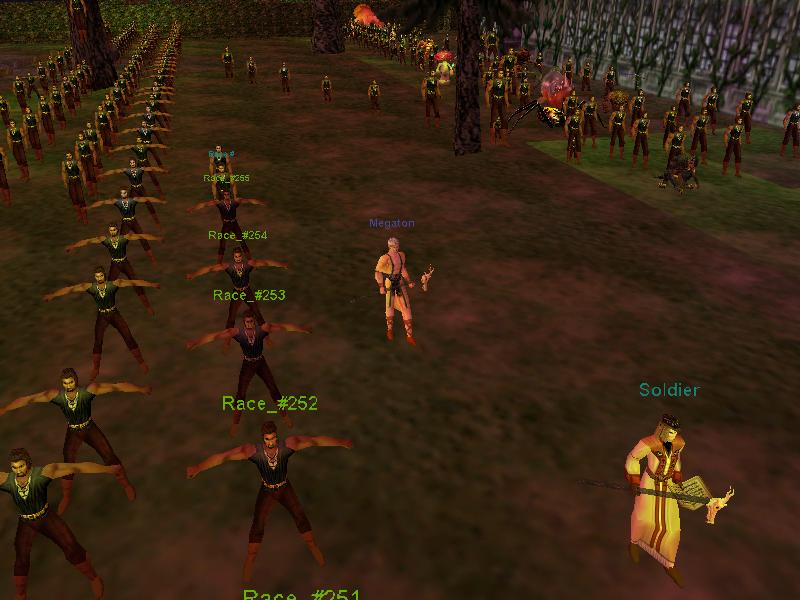
I
was lucky enough to snap a screenshot of my EQ character Blindrunner
as she vanishes entirely from the geometry. This
happened on the unfortunate occasion when I tried playing on a public
computer that did not contain the new Ruins of Kunark
expansion pack geometry information, hoping to resume at the point
I had left off at home. When I unwittingly moved my character into
the expansion Kunark zone (EQ is divided into small
areas known as zones) on this new machine things, the screen went
abstract expressionist, and my character data was lost! Note the random
post apocalyptic graphic artifact [image 11] and the caption read
in the voice of the suddenly anthropomorphized game engine, which
read "I can't find a player named Blindrunner!!". Fortunately, death is not the end in EQ and although I did die, my character was teleported
to another spot in the world, where she was fortunately "found"
later that evening when I returned to play on my home computer.
Much
less dramatic than these geometry traps but extremely common in EQ
are the sites of characters and monsters being embedded in the geometry,
causing only visual artifacts which do not affect the functionality
of the gameplay but do become narrative curiosities in themselves.
Over my many months of gameplay I've come across some amusing
geometric anomalies and managed to snap several screenshots of these
to build quite a personal collection.
4.Player Artifacts Language
EQ
is often described by Verant as a graphical MOO. A strong emphasis
is placed on the chat window on the bottom of the screen. Unlike UO
where the text that characters use to communicate is displayed as
a floating text bubble above the characters 'heads, In EQ all
user interface and inter-player communication takes place in
the text box.
One
of the most interesting problems involving the use of language in
EQ raises from the conflation of conversational language with
the command line interface in the same text box. Language functions
dually to interface with the game mechanics (extra-diegeticaly) and
to communicate between players and NPCs (diegeticaly). Let's look
closely at several linguistic artifacts in this EQ conversation snippet:
Blindrunner says: "Hail Sir Delasa, how may I behold
the path that leadeth to
High hold Pass?"
Delasa responds: "Follow the canyon north and
then turn right at LOC -3456.34, -110.05 keep running east and you
will come upon a Clocktower, HHP is right past that tower. By the
way I wouldn't recommend going there now its 11am on Sunday morning
in the East Coast and the lag is intense. If you're running anything
slower than a Pentium 400 forget about it, in any case if you going
up there I would pick up at least another Tank and probably a Nuker,
EK is mighty dangerous in the dark try to get through it before nightfall,.
Safe journey and Godspeed, Blindrunner"
This
conversation fragment reveals some of the complexity that language
takes on in a game like EQ. The initial question posed by Blindrunner
uses the "role playing" code of language, she is using the
in-game convention of Olde English worded carefully to maintain a
consistency with her notion of the narrative diegesis of the game
world. Delasa's response is more complex. Cutting straight to the
point to avoid excess description of the exact spot where a right
turn is made, he uses the terms "LOC -3456.34, -110.05",
these are map coordinates that any player can access by typing /LOC
in the command line. Although using commands such as /LOC is not considered
cheating, I have had conversations in-game where I've used LOC coordinates
and players would respond with feigned confusion, claiming they have
no idea what I am babbling about. Such narrative moments posses an
ironic beauty as players struggle to assert their divergent worldviews,
defining the scope of their fantasy and marking the boundaries
of their diegesis. These exchanges may resemble those between
a devout Creationist and a secular Paleontologist, as their divergent
epistemologies are contested, neither will concede a "leap of
faith" nor in turn a "leap of logic".
The
next curious term Delasa uses is "HHP". "HHP"
is the common acronym for High Hold Pass, a commonly traveled mountain
crossroads in EQ. The use of acronyms in EQ is very
common and functions in various ways to affect narrative. Acronyms
are a tool of action and a function of speed and pragmatism. Although
their use in fiction often serves an aesthetic function of asserting
a linguistic style, in chat based games their primary reason-d'être
is efficiency of communication. The games' action moves fast, and
those who want to keep up, must adapt and shape their language to
match the speed of the action.
Additionally, The use of acronyms in EQ and other linguistic
communities is a sign of deep linguistic immersion, as actors in the
community become more experienced with their context and more deeply
immersed in its specific use of language. Familiar from the experience
of reading Anthony Burgess's "A Clockwork Orange"[2] and many Sci-Fi and Cyberpunk novels, initiation into a vernacular
is a narrative device very commonly used in Science-Fiction novels
to heighten a sense of immersion. As the reader progresses through
the narrative, the struggle of learning the vernacular functions as
an initiation into the world of the characters in the story. This
process is very acute in Burgess, while the reader gradually struggles
to learn the language/slang of the "droogs", he/she experiences
a symbolic initiation into their clan.
The
next fragment of Delasa's response reads:" now its 11am on
Sunday morning in the East Coast and the lag is intense. If you're
running anything slower than a Pentium 400 forget about it".
Delasa's response is blending technical and social observations
relating to matters of the "real world", by addressing real
spaces, timezones and technologies. These linguistic spillages between
the virtual and physical world are very common in games like EQ.
Negotiating these two frames of reference is a skill that quickly
becomes second nature to game players, and casual seamless transitions
are natural elements of in-game communication.
The
developers of EQ are not unaware of the fact that players will
need to use technical and other extra-diegetic terms when communicating
with each other. The chat function provides a special "Out of
Character" mode, intended specifically for these interactions.
When using the "Out Of Character" chat mode, the chat text
turns a bright green and is displayed with the "out of Character"
Qualifier as in "Blindrunner says out of character "I
don't like switching modes like this all the time" ".
The
next elements of interest in Delasa's response are his use of the
terms "Tank" and "Nuker". These terms borrowed
from a technological/military context refer in turn to a warrior and
a wizard. The substitution of the term "Tank" for warrior
is so common in the EQ vernacular that I can scarcely recall
ever hearing a warrior called anything but a "Tank".
The invasion of techno-militaristic terms into the fantasy diegsis
is familiar from player's often choosing character names borrowed
from pop culture and break the illusion of a deep fantasy. One very
important difference exists between "infractions" in character
naming and in game conversation. Whereas the mayhem created by players'
breaking of the naming convention rules is easily tracked by the EQ
staff and the perpetrators can be singled out and punished
[11]
, linguistic infractions made on the public vernacular
are a result of a communal impetus and cannot be tracked to any individual
culprit. Moreover, not only will nobody be punished for these aberrations,
but any attempt by the EQ staff towards censorship in the public
sphere would create such a severe backlash from the player community
that it would prove an fateful choice from a public relations and
marketing standpoint. As can be seen by these examples of
some of the linguistic complexities involved in these games, the arena of language in the corporate run hetrotopias of MMORPGs
remains the most polemically dynamic. This linguistic space is the
one arena left in the gameworld where the community of players as
a whole hold the empirically uncontested authority both as authors
and as eager consumers who must remain satisfied. Hacks
and Cheats
The
stakes involved in protecting MMORPGs from hackers are extremely high.
If a player hacks a single person game that he or she may be playing
at home, the game may only be "ruined" for that player who
has chosen to "ruin" the game for him or herself. In contrast,
when an online game player manages to hack the game the affect is
quickly spread to all the other players involved. In the case of MMORPGs
millions may be affected as these social games are based on a very
careful game balance where players take years to advance to high levels
and are entwined in complex social relationships that rely heavily
on notoriety and experience.
EQ
is supposed to be unhackable. Yet the net finds several rather interesting
software packages available for free download or sale that alter the
gameplaying experience. The first of these unsolicited EQ "add-ons"
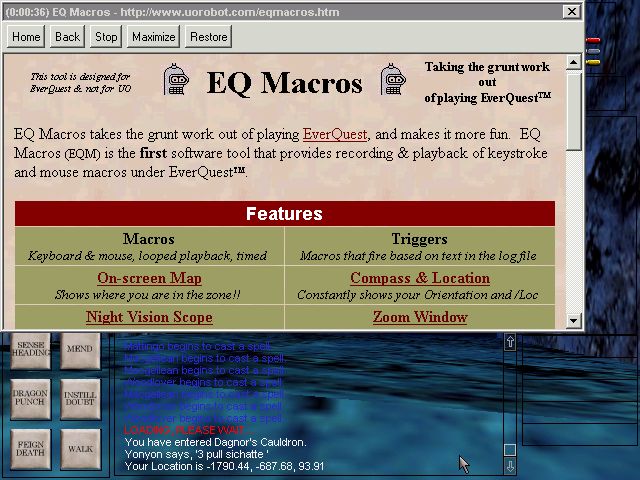
to appear on the scene was EQ Macros. EQ Macros is an
EQ version of the older UO Macros created for UO.
Initially the purpose of this software was to allow players of UO
to program their characters to perform repetitive tasks automatically.
Both UO and EQ use a skill system where a specific skill
will increase in direct proportion to the number of times it is used.
Say for example, if I wanted to improve my skill with a bow and arrow
I would shoot at a creature or target two dozen times and my skill
would then increase from a rating of 1 to a rating of 2 making it
slightly easier for me to hit my target with a bow and arrow. Additionally
as a character gets better with a certain skill that skill then requires
more attempts to increase. Players can often be seen "practicing"
their fishing, backing or swordfighting skills by standing in one
place for hours or even days performing the same repetitive task!
Aside from the potential for affecting carpal tunnel syndrome or other
physical or mental complications, the boredom and drudgery are ridiculous.
And yet this is not at all an unusual practice as players often prioritize
the narrative of personal improvement and mastery over the in-game
quests which some see as being just as boring and repetitive as shooting
an arrow at a tree for three weeks. So, to improve rapidly without
personal risk, simply download and install UO Macros or EQ
Macros, maneuver your character to the end of a lake, equip her
with a fishing pole, run the macro software, go to work for eight
hours. When you return from work, Viola! Your character is now a master
fisherman able to catch and sell fish with ease, using the quick profits
to purchase that new shinning armor or magical wand you always dreamed
of. Some players who were unsatisfied with the options of the macroing
software have designed their own mechanical robots to perform specific
key presses and reproduce mouse movements.
When
UO was originally released the game developers did nothing
to discourage software packages like UO macros. In fact they
established business partnerships with 3rd party developers. Their
logic was that hackers will do this sort of thing anyhow, and if you
can't beat them you might as well join then. Or maybe their plan had
been more crafty then that all along. After many months of sanctioned
software partnerships these relationships were suddenly severed; having
learned the tricks of the trade the developers were now equipped to
program in-game provisions that counteracted software tricks like
Macroing and packet sniffing[footnote?]. EQ, released
two years on the heals of UO, takes a more direct approach
and forbids all players from using 3rd party software. Every time
a player connects to the EQ servers they are required to "accept"
a license agreement stating that they will jeopardize the status of
their account if they break any of the many rules of conduct.
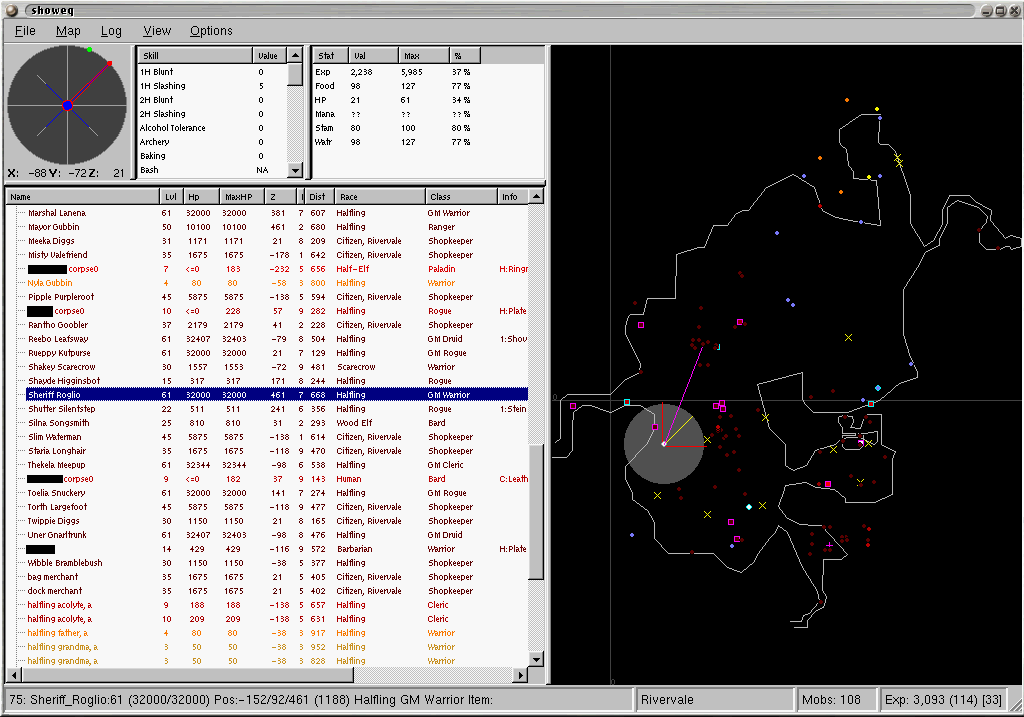
Show
EQ screenshot
I
find the Macroing and Show EQ phenomena to be the most wonderful
examples of the kind of mutated hybrid fantasy that emerges when the
capabilities of high tech computer technology, a web savvy audience
raised on open source ingenuity conflates with a complex corporately
controlled narrative framework and turns into a techo playground for
subversive action. When relating to Verant, the company that
develops and maintains EQ, the language used by many higher
level players conveys a sense of paranoia and revolt. The narrative
becomes about beating the system, taking it to the man, all the while
cautious that big brother is always watching. Many tech savvy MMORPG
players easily exchange the initial context of the medieval fantasy
game narrative along with its potential rewards, with a David vs.
Goliath, hacker versus corporation narrative of personal control and
liberation. I propose that for those tech savvy players a complex
of forced inferiority, frustration and paranoia results from the confining
limits of the first person perspective that MMORPGs privilege. Seen
in the wider context of other software/narratives such as Internet
browsers and GUI operating systems that allow more visual control
over digital space, or text based operating systems such as Linux,
Unix or DOS that allow knowledgeable users access to all files on
their system, the "end-user" mode of first person 3D perspective
coupled with limited access to files, positions the players of MMORPGs
at the bottom of the command and control hierarchy of the system
[12]
. Take for example games belonging to the popular
genre of Realtime Strategy Simulation (RTS) games , such as StartCraft,
Age of Empires, Sim City, Command &
Conquer(!) or the Sims where the player is awarded a "god's
eye" perspective and a god's status. These games usually involve
control of dozens or sometimes hundreds of semi autonomous minions,
and the player is free to roam and examine every corner of the game
space. Show EQ is astounding as a testament to the phenomenological
notion that vision is liberating and immersion oppressive. Show
EQ liberates the player from the role of player-puppet to that
of director, from minion to towering clairvoyant magician, from grounded
grunt to airborne general. As it transforms the narrative of EQ
into a database collected and processed into categories of friend/foe,
attainable/unattainable, valuable/disposable, all metaphoric references
are removed from the narrative and what remains is a clear narrative
of control over variables, numbers and perhaps most significantly,
of the corporate rationing of power.
CONCLUSION...I
hope that the methods and structure that I've introduced to examine
the first wave of fantasy MMORPG software/narrative hybrids will prove
useful both as a first hand record of these moments in pop media history,
and as tools offered to further examine the evolution of MMORPGs and
the embroiled narrative of Magical Fantasy and Technology.
Much
like the plotlines of MMORPGs, the story told here is a tale with
no end. I recently installed and began to play the new MMORPG Dark
Age of Camelot, and there are already new stories to tell, and
new artifacts to collect. New layers of metaphoric patches have been
introduced, several technological artifacts have been removed and
new ones taken hold, anti-hacking security has been heightened as
new hacks are being devised, and new linguistic forms are born
[13]
.
REFERENCES
1.
Arcanum, official website. "http://arcanum.sierra.com/"
2.
Burgess, A.. A Clockwork Orange. Heinemann,
1962
3.
Davis, Erik. Techgnosis, Harmony 1998
4.
Eco, U. Travels in Hyperreality, HBJ
1986
5.
Everquest, oficial Website. "http://everquest.station.sony.com/"
6.
Flint, I.J.V. The Rise of Magic in
Early Medieval Europe, Princeton, 1991
7.
Gibson, W. Neuromancer. Ace, 1984
8.
Gimpel, J. The Medieval Machine, Penguin,
1976
9.
Hafner, K. and Lyon, M. Where Wizards
Stay Up Late: The Origins of the Internet, Simon & Shuster, 1996
10.
Smith, R (ed.). State of the Online
Union, in PC GAMER, Feb 2002 issue
11.
Stephenson, N. Snow Crash. Bantam
Books, 1992
[2] The Church later pragmatically generated its own incarnations of "holy" magic when monotheistic reason didn't work to convert the magically inclined pagens. This is not entirely unlike the marketing strategy of parallel marketing that promoted Coca-Cola and Pepsi Co. to market their bottled waters Aquafina and Desani to those last few uncooperative consumers still resisting the red, white and blue gods of sugar and caffine. [3] Everquest players often refer to the game by its all too telling nickname EverCrack. The reference here, just to be clear, is to the drug. [4] After writing this hypothetical backstory for Tetris I came upon Lev Manovich's uncannily similar description of his algorithm of Tetris (The Language of New Media, pp220). [5] Distinguishing genres in reference to computer games requires a splitting into medium-genre and message-genre, so we need to cast games as belonging to the Science Fiction / First Person Shooter(SF/FPS) genre or the Military / Real time Strategy (MIL/RTS) genre. But MMORPGs have traditionally belonged to the /Fantasy variety, and only very recently, more than three years after MMORPGs emerged do we see the/Mil and /Sci-Fi incarnations of "World War 2 Online" and "Anarchy Online". [6] Asheron's Call stands out here in that a clear and strong emphasis is made to create an epic over arching narrative that affects all players in the game and fits in synchronically with the backstory. Ultima Online, EQ and Diablo all seem frozen in time with regards to the "grand narrative" of their respective backstories. [7] Consider the "All your base are belong to us" web phenomena, which stemmed from the mockery of a grammatically challenged NPC as much as from an Anglocentric juvenile reverie [8] Even though high level characters will often wait in one spot for days to aquire a rare magical item dropped by a rare spawned creature [9] Non linear access to data is the foundation upon which hypertext and Internet navigation are built and curiously the term "Portal" has found a home in the current Internet Vernacular. In this context the term Portal is used in reference to any Internet gateway; A portal may be a search engine homepage like google.com or Yahoo.com, an ISP custom browser/portal like AOL, Earthlink, or MSN, or even a keyboard Portal at the hardware level like the "home page" and "Internet" buttons found on my Compaq PC keyboard. [10] Read, Write and Execute privileges, are known as 777 privs in Unix and Linux jargon. [11] The punishment for these sorts of crimes is the permanent banning of the player's EQ account. [12] A larger discussion than the scope of this article permits may venture further to speculate on the seemingly contradictory network of relationships that visually impaired command line operating systems like Linux and DOS may have both to an open source movement and a monopolizing corporation. Command line control offers exact control over the environment for those tech savvy enough to master the commands, whereas a windows OS is much more liberating for those less tech savvy users. This is a complicated question that could be investigated in depth. [13] Most of the in game vernacular has been appropriated directly from EQ, |